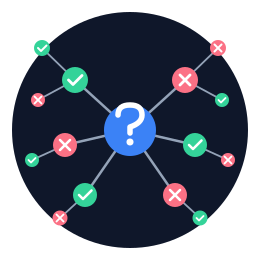
Explore both sides of any debate
You've already made up your mind. But have you seen the other side?
Most debates look simple - until you see the arguments you missed.
No signup needed
Same facts, different conclusions
Different ratings. Different outcomes.
See why reasonable people reach different conclusions - same arguments, weighted differently.
- 1Structured
- 2Rated
- 3Both sides
Unlike social media debates, both sides are always visible and structured - no algorithm decides what you see.
Ready to see both sides?
Pick any topic. See the strongest arguments for and against. Decide for yourself.
Start exploring debatesNo signup needed
Frequently asked questions
- Claims can be private, group-only, or public. Private claims are never visible to anyone else. Group claims require admin approval to join.
- Click the colored bars to rate how true an argument is (from false to true). Click the dots to rate how relevant it is to the topic. You can change your ratings anytime.
- Each claim shows a score from red (false) through neutral to green (true). It combines how the community rated its truthfulness with the strength of supporting and opposing arguments. The more people rate, the more accurate it gets.
- Groups let you share claims with a closed audience. Members request to join and an admin approves. Group claims are invisible to non-members.
- Yes. Use the Link existing claim button on any claim page to search for and connect an existing claim as pro or contra. Circular references are automatically prevented.
- The interface is available in English, German, and Spanish. Claims are written in one language - you can filter by your language or browse all.
- Click the AI button on any claim to discover pro and contra arguments you might have missed. The AI searches for scientific sources and generates structured arguments. You review and select which ones to add.
- Fact-checkers give you a verdict. ArguCheck gives you all the arguments and lets you decide. You see both sides, rate what you find convincing, and the score reflects the community's collective judgment - not one editor's opinion.
- You control visibility for every claim: Private (only you), Group (invite-only team), or Public (open community). No emails or real names are exposed - only nicknames.
- Each claim shows a color-coded score: green means the community thinks it is mostly true, red means mostly false. The score combines two things: how people rated the claim's truthfulness, and how strong the pro and contra arguments are (weighted by their relevance).
Is my content private?
How does rating work?
How is the score calculated?
What are groups?
Can I link existing claims?
What languages are supported?
How does the AI argument finder work?
How is this different from a fact-checker?
Is my data private?
How is the score calculated?
Key concepts
- Claim
- A debatable statement, e.g. Universal basic income would reduce poverty. Claims can have sub-claims (pro/contra) forming a reasoning tree.
- Relation
- A pro or contra connection between two claims. Users rate how relevant each connection is.
- Pro
- An argument supporting the parent claim.
- Contra
- An argument opposing the parent claim.
- Truth Rating
- Is this claim true? Rate it from definitely false to definitely true by clicking the colored bars.
- Relevance Rating
- How relevant is this argument to the topic? Rate it by clicking the dots - from irrelevant to core argument.